Friday, October 18, 2013

Here is another view of what we are about.


Wednesday, September 18, 2013

Leaf Cooking Classes in Belin

Chepe's wife, Paula, has been diagnosed with early onset diabetes. We talked about it a couple of weeks ago and agreed to go to her house to show her how to cook green leaves in different ways. She and Chepe organized a number of neighbouring women to come as well. We had 12 women of various ages. Yeni, Maricella and I cooked up 6 different types of leaves, made green, Moringa powder tortillas, made peanut butter and peanut butter/banana milkshakes. All of the recipes were well received. Phew.
Adding Moringa Powder to Masa for Tortillas

Making Green Tortillas

Taste testing Moringa powder

Rocket Stove ... roasting peanuts for peanut butter

Yeni showing the various leaves

Tuesday, September 17, 2013

Parade

Sunday was Independence Day in Honduras. In honour of that day scores of towns and cities held parades ... some starting on Saturday. Sunday morning was the time for all of the private (non-public in our case) schools to march through town. We were to be in place by 7 a.m. for a 7.30 start. By 8.45 we were underway.
 
First leg ... still looking fresh

Stalled again - the church in the background

Last leg - 20 metres to go

Acknowledging the flag by the reviewing stand

Almost done - Phew

As each school passed the review stand, they were heralded by a pair of 'play-by-play' announcers who took their job very seriously. A few of the schools thought that this was the time they were to put on 20 minute performances. Thus, for the rest of us, the parade consisted of standing, sliding forward 50 metres, standing and so forth. It only took four hours for us to traverse the 9 blocks to the review stand. These are Santa Cruz blocks which are about 1/3 the size of a Canadian city block.

I should have had a hat. Today I look a bit like a semaphore.

The good news though was that almost 200 students showed up to march so we were the largest contingent. As well, because we took so long, many people who were waiting for other schools or just watching got to see our school for the first time.

This morning, the staff were looking through some of the pictures. My turn will come in a little bit and I will let you see a few as well.

TTYL

BB

Friday, September 13, 2013

Children's Day

Yesterday we celebrated children's day at the school. Lots of students and lots of children ... a number of our students are young mothers or, in one case, a brother who must care for his younger sibling while his mother works.

Pinata destruction time. 

Yeni and her daughter Ady. Serve the cake please ... don't eat it.

Not everyone enjoyed every activity.


Someone has to say no to those sometimes. Don't envy them.

Staff filling the pinatas ... we really do have a happy workplace.

Wednesday, August 21, 2013

More Crochet Stuff

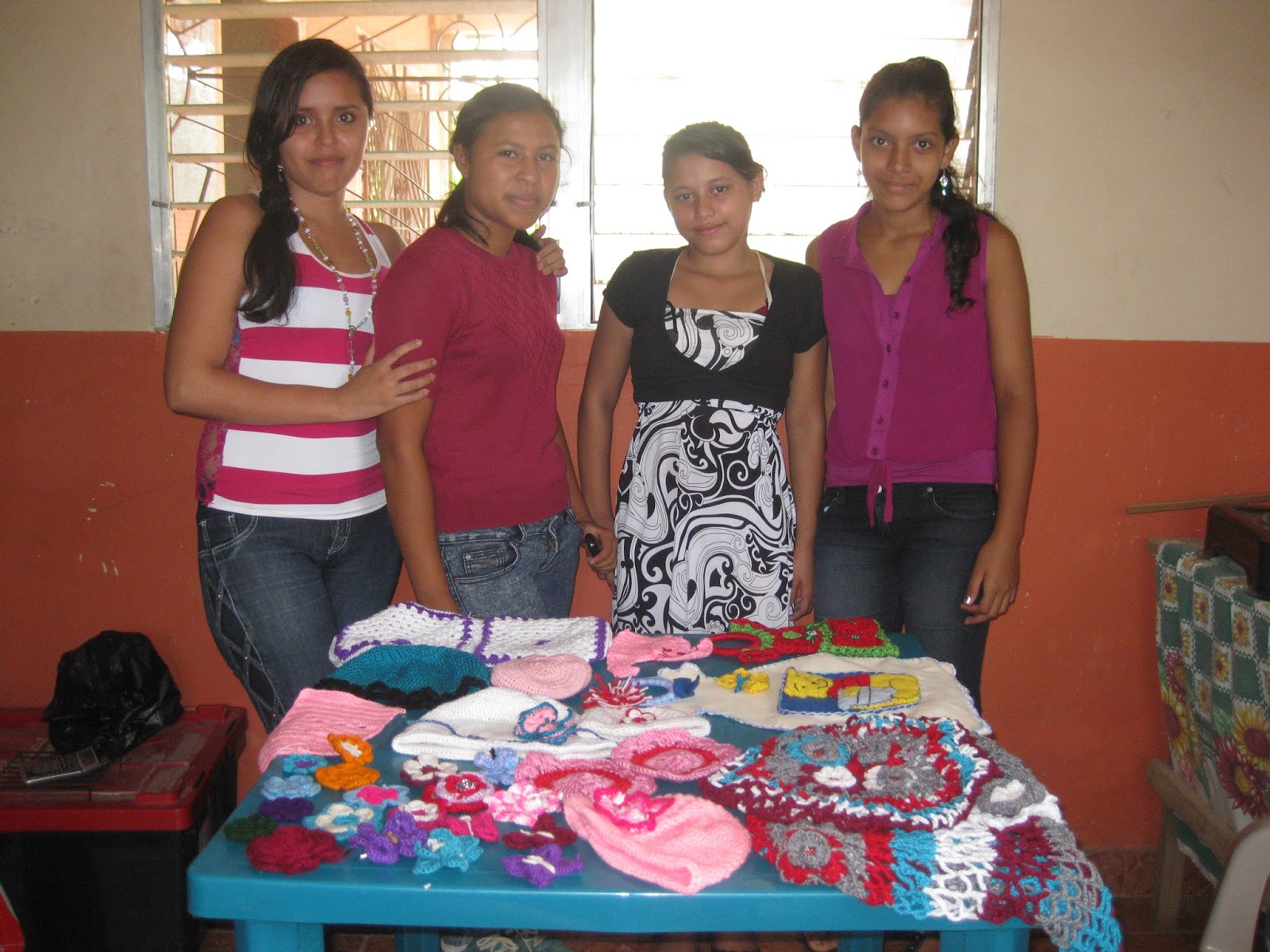
Yeni organized students to bring the things they are making to get a picture. Here are four of the students who have learned crocheting. There are others as well. Ardythe gave the staff some needles in January and they have progressed amazingly well. She brought down some pattern books this week and is also going to teach them some nifty things like parachutes and so forth.
Some of the students' work

Four of the girls and their work

The students are learning a skill. Check. They are, also, learning to use spare time to advantage. Check, check. They are finding out that they can find ways to earn money themselves. Check. As well, they are discovering (probably in an oblique sort of way) that when you are making money you are not spending it. Check.
Ardythe shows the staff some pattern books

I am so impressed with the variety of things they are making.

TTYL
BB

Monday, August 12, 2013

Another Edible Plant

Last week, a friend sent me a chart with the protein values for a number of potential animal feeds. The word Malanga jumped out at me with huge protein numbers. Very surprising. Then, another part said that the leaves were edible for people.

Malanga grows almost wild here in Honduras and inhabits any and most swampy or damp areas. Drainage ditches, wet stream banks and roadsides all seem to be sprouting this plant.

Malanga is a relative (quite a distant cousin in some ways) of the Taro plant. The roots are very tasty and are used in soups especially. Quite nutritious but, also, quite full of starch.


Right now, there is a big boom in malanga planting in Honduras because of the export market. Evidently it is gaining popularity in the United States. As you can imagine, that means even more leaves available for nutrition.


Saturday morning, a friend of mine helped me collect a few leaves. At home, I cut off the stems and the large central ribs and pressure cooked them for 10 minutes (on the advice of Leaf For Life director, David Kennedy). Gingerly, I tried two spoonfuls and waited an hour. No ill effects. (The leaves have a chemical that really makes your mouth and throat feel on fire when you eat them raw - Chepe and I know this from experience). An hour later I chowed down the leaves with vinegar and pepper.  All good.

This week we will try cabbage rolls with rice or a type of tamale with masa (maize paste used in tortillas). Will see if they turn out.


Interesting note. Evidently duck eggs are seen as having special nutritional or beneficial properties. Yeni's little girl, Ady, was taught by her grandmother how to tap one end on the table, make a small hole and suck them down. She does so with gusto ... while her mother tries to look as if it is nothing unusual.

Fish still living. We have ten in each tank now. Our middle tank was not thriving as well as the other two. We found out why. When we bought the fry, the man threw in a few extra. It turned out that, while there were 10 in the other two tanks, there were 90 in the middle one. Good news. They were living. They were growing (very slowly). They were making do on Moringa powder.

For any readers who are not aware, http://www.whatisinyourhand.org/  Ideas for Hope, a website with my textbook and various booklets is up and running.

TTYL
BB

Monday, July 29, 2013

Enjoying A Trip

Living in Honduras offers many opportunities to see beautiful scenery and experience new adventures. It is hard, sometimes, to think of what I am doing certain moments as work. This last week was filled with such moments.

On Wednesday, I flew to Belize City to attend a conference on Aquaponics (raising fish and vegetables together). The conference featured Nelson and Pade Aquaponics founders and was something I had hoped to attend for some years. Having it in Belize City was a real opportunity.
 
Holding the post up while Jimmi does the work - I did carry the gravel and dirt ... just so you know
The short flight to Belize was in a twelve-seater plane. Flying in small planes is so much more fun than large ones. We were able to watch all the dials and maps on the pilot console and, because we flew so much lower, able to see the gorgeous reefs, islands and empty shorelines clearly. A bank of cumulus clouds made the trip more exciting as we dodged through the openings.

Belize is a British colony and features Her Majesty's picture on their currency. I felt right at home. The difference in culture between the two countries is really amazing. Language is, of course different with a mixture of English, Garifuna, Creole and Caribbean dialect instead of Spanish. The food is different as well - a mixture of English, Indian, African and some Spanish. Many more spices and flavours are part of the diet. For a Prairie boy, mashed potatoes was a wonderful treat.

The conference was enjoyable although not as informative as I had hoped. Our focus in Honduras is finding simple ways for the poor to grow food, address nutritional concerns and find new sources of income. They don't need large systems with a heavy reliance on technical equipment and large sources of energy.
 
A ferro-cement tank being built by my friend Glen - I helped with design ideas and taking him to see some already-made tanks (so ... get part of the credit ... enough to post a photo anyways)
It is very difficult for people who have not lived any length of time outside of their culture to appreciate the need for food systems that are small, simple but utilize good science and a modicum of technology. Our culture is a mono-culture based way of thinking - in agriculture, in business and, often, in religion. To switch to a poly-culture, integrated and multi-use way of thinking is a struggle.

Fortunately, I was able to spend a day with Jimmi and Sandra, a couple who have a small aquaponics system in Belize and who are looking at ways to make it more integrated and multi-faceted. We discussed many ideas and how to implement them - both in Belize and here in Honduras. Jimmi has several years experience and has learned what must be done and what can be left undone. As well, because we have talked for some time, he is interested in using his waste streams to better effect. Despite the efficiency of his system, he has room to easily double or triple his income by utilizing the waste streams of plant material, fish carcasses, fish manure and space management.
 
Karen showing her purse (lined with a zipper top)
We spent a couple of hours making some wicking beds where Jimmi will try growing alternative crops. That was enjoyable although, at 2.00 p.m. in the greenhouse rather warm.

The flight back was as enjoyable as the first flight. It was nice to be home in good time to have a few hours of Sunday rest.

Karen finished her first crocheted purse. I am so impressed with the way in which students are learning how to crochet and the way in which Yeni, Ana and Maricella are teaching them.

TTYL

BB