Sunday, March 3, 2013

Opening Day

Front of the school

Back of the school

Program Begins

Guests - Tegucigulpa and Canada represented

Lab section

CPI Board Cuts the ribbon

Students cutting the ribbon

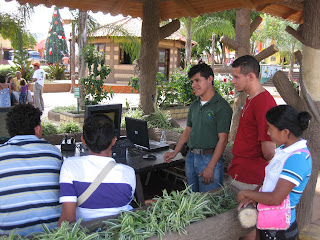
Students getting to try the program

Frieda, Canadian CPI Board member presents edible leaf plants for the school

C.E.F. staff

Trinidad and Teresa - the real force behind this program

Friday, February 22, 2013

Day 9

Making progress.
 
The Computer Lab part painted. Windows in today ... we hope.

Rafters up - the stringers are on as well today.

Thursday, February 21, 2013

Evaluating A Project

Some thoughts on evaluating projects. Sometimes we beat ourselves up because we look at the empty space in the glass rather than how full it really is. There are, I think, better ways of looking back.

1. Did you do your best?
                - Your best does not have to equal or be better than someone else's best.
                - You will always find someone who's best is better than yours.
                - You can often find someone who's best is worse than yours.
                - DON'T compare your best with that of others.

2. How did your best affect the poor?
                - Did the poor live better lives because of your efforts?
                - Were the poor more equipped to help themselves?
                - Did the poor feel more self-confident in their own abilities
                       and in their own "best"?
                - Did your best cost the poor more than they received?
                - Did your best allow the poor to teach you something?
                - Did your best exclude any groups of people?

3. How did your best affect the earth?
                - Did your best cost the earth more than she received?
                - Is the end result of your best a benefit to the earth?

4. How did your best affect yourself?
                - Did your best cost yourself more than you received?
                - Were you able to learn from the situation?
                - Is your next best going to be better?
                - Will others connected with your best be able to do better as well?
                - Is your best something that will positively affect your "grandchildren"?
                - Did your box get bigger?

5. Was your best skewed towards pleasing the rich or the poor?
                - Who benefitted the most?
                - Did your best narrow the gap between rich and poor?
                - Did any rich see the poor with new eyes and new appreciation?

6. Does your best make earth a place of value or a place to escape?
         (In Christian terms - Thy Kingdom come on earth ...)

7. Would you do it again?
                - What reasons do you have?
 
Irrelevant Considerations
 
1. Could your best have been better? Of course it could have been better.

2. Was your best successful in terms of material gain, things built, prizes won?

Tuesday, February 19, 2013

Container News

The container classroom continues to evolve. An unexpected two days of heavy rain and cold weather stopped construction for a bit. We have to push back the opening day by a week to make sure all gets done. The good news is that a Canadian contingent will be able to be there for the grand opening.

Today, the men are working on finishing the walls, building the rafters, putting together the storage shelves and some electrical work. Together, we have come up with some creative solutions to various problems and situations. For the most part, my parts list and my plans have been spot on. Phew.
Computer Station desk being built - Carlos and Andres

Day 4 - Framing in the windows and ventelation


Various members of the village have come out of the woodwork to help with various parts of the project and have provided skills that have saved the day. That is exciting to see. As the pieces come together, people are able to see what I have been "seeing" for a long time.

Today, in the office, we looked at a container village/orphanage in South Africa. Truly amazing. As we talked, we thought of how a container could be used vertically to create a coffee/maize/bean dryer. The chimney effect would create a great deal of air movement. Yet another idea to put in the "must try some day" pile. And something else to think about while driving.

Friday, as we worked on the container, we talked about soda and the cost to the village. The men gave me some figures and I did the multiplication for them ... my calculator being a bit quicker. Las Delicias is a village of about 110 families. Using the lowest figures that they came up with, we found out that the village spends a minimum of $36,000.00 a year on soda. In farming terms, they need to plant more than 70 acres of maize to pay for their soda habit (not counting the costs to health) ... all by hand.  I was totally blown away by these numbers (went over them a bunch of times to make sure I wasn't out to lunch). Using the figures of some of the men, the number could easily be double that.
No power - time to varnish shelves and desk tops
We had another interesting discussion last week with a couple of the workers. Two of them, who work part time here, were looking for work in San Pedro. We began to do the math of what they would earn and what they would take home ... and for what cost to themselves and their bodies.

It turns out that for a 10 - 11 hour day ... 7 days a week, they would take home (after rent, food and transport) $25.00 a month. The figure does not include spending on personal items, clothes and medical. As well, the girls would be travelling in the dark at least one way so their personal risk would be considerable.

Obviously, we began to explore other options. We will see if they try and take advantage of some of the skills they have learned here.
Morning of Day 5 - All the framing of doors and windows done, interior walls nearly finished.
The teachers in the high school have been telling their students that our school is a good place to do their practicums at. That is good news for us. Three young men have already come to see about booking a place for September. Can you believe that?  Young boys thinking six months ahead of time? Excuse me while I sit back and massage my heart for a moment.

Will stop and let the pictures do the rest of the talking.

TTYL
BB

Thursday, February 7, 2013

Container School - Day 1

The container is now in Las Delicias. When one says that simple sentence it has no reflection on the amount of energy required to accomplish that.
Arriving in the village - Men ready to lift power lines

In the valley just before the last climb into the village

The container arrived in Santa Cruz an hour early. However, one block on the way to Las Delicias, it developed a mechanical problem. All said, we sat until 3.00 p.m. when another tractor arrived to help out. This was a minor problem because Honduras was due to play the United States in a soccer game at 3.00 p.m. Sigh. The sacrifices we make to bring education to Honduras.

By 5.00 p.m. we had made the journey to Las Delicias. Fortunately, Chepe, our chairman, had a friend with a big truck. We used that truck a great deal last night. It helped the container truck up one steep stretch and then helped pull the container off the trailer.
Halfway point

Current location of the "school" - 40 students study in this small living room/dining room

At the bottom of the hill to Las Delicias, Trinidad and other community members were waiting (as they had for 8 hours) to help out on the steep climb into the village. Everyone was out to watch the container arrive. Talk about being better than a movie.

Raul suggested that he would like to try taking the container off the trailer. This was fine because it would save us a great deal of money if we didn't have to bring in a big forklift or crane (which was scheduled to come early this morning). Three hours later, the container was sitting on its four foundation tires in, basically, the right place. Amazing what enough hands can accomplish. Hydraulic jacks are truly a wonderful invention. A small jack that is used to change a tire can life the corner of a huge container. We used the jacks extensively.
Hooking up the chain for the one of the really tight corners
 

We stopped for a supper of baleadas and coffee which was very welcome. The village men and boys kept getting the container moved to the right spot and set on the tires.

I left Las Delicias at 9.00 and was home by 10.00 - ten miles. Two students had gone with me for the adventure and so the trip was enjoyable ... especially if you like Ranchero music played at full volume.
First stage of unloading - lifting the container off the pins.

Next week we will start the construction process. I am confident it will go together nicely but, at the same time, super nervous that I have forgotten a major item in the budget list.

TTYL
BB

Monday, January 21, 2013

El Chilar

On Friday past we were able to go up to a small village above Copan and give certificates to several students who finished a grade. It was cold (18' C or so) so all were bundled up. I was so happy that the car we rode up in had a heater.

At the gathering, I was able to show the students how to prepare a banana flower and the stem of the plant. It is painfully obvious that malnutrition stalks the children of this area with a vengeance. Any plants that can augment their diet are desperately needed. We also left some Lablab seeds (a type of bean that provides a great deal of green manure, edible leaves and seeds).
Manuel and I checking the boundaries for our next housing project - not seen ... the tiny insects that left our ankles itching for the next 6 days.

El Chilar graduates in the local primary school

Carol, an Albertan, who is providing the computers for these students.
The banana evangelist showing the edible core of the banana stem. The white debris below is, likely, also edible. It is certainly a good feedstock for animals.

As we drove up the hills to El Chilar we passed two trucks offloading groups of people. They were families with young, primary school children among them. They were returning from the higher hills where they had all been picking coffee for a week. I have no idea where and how they slept, what they ate (and if?) and what the sanitation facilities were like. It was a sobering reminder of the cost of a cup of coffee in social terms.

Accounting update:  It seems as if all the staff are keeping track of their money now. A couple showed me their books from a week of recording. Amazing. Edel, who supports a mother and two sisters, bought a small notebook for each of them and, last Tuesday, told me that the next day was the day of reviewing their week's worth of records. I have yet to find out how the "judgement" day went.

Everyone is amazed to see how the money is spent. A friend of Edel's noticed his notebook and asked why bother. They talked and Edel asked the friend what he had for lunch each day. The friend said he had a coke each day. The upshot of the conversation was that Edel did the math with his phone calculator and showed his friend how he was spending over 10,000 lempiras ($500.00 and about 1.75 month's salary) a year on soda. He also has to buy medicine to deal with the stomach problems caused by the coke. Both of them were totally shocked.

Last weekend we drove along the coast of Honduras. Enormous swathes of the coastal plains are being planted to oil palm. Millions of plants are being grown in nurseries and then being planted out. It was deeply troubling to see this monoculture robbing the area of diversity and potential. Oil palms provide income for large landowners but very little employment per unit of area. As well, there is no biodiversity and nothing of nutritional value for local people to benefit from. For the landowner, oil palms are a great option. They don't really have to protect the harvest ... hand production of oil hasn't really hit the scene here. They don't have to pay large labour costs and the trees last for many years.

For the peasants, after four or five years the canopy closes over and there is no space to plant maize, beans, edible plants and fodder. Large acreages of land which would, at the least, have provided small pockets of places to grow food are now taken out of the picture. The palms allow no ground cover so the soil is bare and open to erosion.

Of course, the processing of the oil is controlled by a handful (or fewer) of plant operators. They control the price, the transport, the production and the sale. Wealth becomes concentrated in fewer and fewer hands.

That is enough for today.

TTYL
BB

Friday, January 11, 2013

Town Square Demonstrations

Happy New Year.

 After a Christmas break, the staff are back and things are bustling. I thought that Monday would be a sort of relaxed, get-back-into-things sort of day. And it was ... for about forty minutes. By then, mothers and children had begun lining up to see about registering for our school year. For the next three days we have had people waiting outside for most of the day. Truly amazing and very rewarding.

Other centres are also gearing up to start with our program this year. That is very exciting to see the program spreading slowly to more corners of the country. Yesterday and today, we are setting up computers in the town square to show off the program. It is fun to have a program which is interesting enough and simple enough for people to stop and understand quickly.
Yeni and Edel (in school uniforms) - two students working on the computers

Potential students checking out the screens

Yesterday, another group of potential students came to visit. There are a group of poor women who sweep the streets in Santa Cruz. The Mayor told them about our program and they came to see if they could study with us. We will have to organize a way for them to study. These are, for the most part, single mothers who make enough for subsistence living keeping the streets clean. Of course, from my perspective, this is what we are all about. It will be so exciting to get them studying.

A diabetic lady has been coming to buy Moringa leaf powder this week. It is nice to have it available and to know that it is actually making a difference in her health. Even though it costs me money to produce, I hate to charge for it. But ... it needs to be worth something. We will try and find a scale this week so that we can measure out the powder more accurately.  A new dryer system will hopefully increase the amount of powder we have available.

I noticed the staff looking at a bookkeeping program Wednesday afternoon. We talked about accounting and I mentioned that all accounting is simply "In", "Out" and Balance. Everything else is just an extension of that principle. We talked about how, for the most part, people who have money know where it is going and those who are poor generally don't. So, I gave them some exercises to do. Surprisingly, three of the staff went home and wrote down a simple journal of their expenses for the day and brought it to show me the next morning. Last night, another staff member was in a store buying tiny notebooks for his two sisters so that they would begin writing stuff down. So ... maybe the little notebook that I carry in my shirt pocket to record my spending is having an effect. (Do not expect to see family pictures of me and my family all sporting pens and notebooks in their shirt pockets any time soon.)

Each of my staff have people who look to them to provide some money. So, they are all vulnerable to having their salary get eaten before they know what has happened. By keeping track of their spending, they have an opportunity to see who and how their money disappears. In addition, having access to computers here at the school means that they can design spreadsheets with multiple columns to show their own particular types of expenditures over time.

Wednesday evening I found that a young mother who does some work for me had been stung by a scorpion the night before. Her foot was quite swollen and she was in obvious discomfort. We took her to the clinic and she got some help. Obviously the effects of scorpion stings here is different from those in Africa. As my friend in Kenya put it, "A scorpion sting is 24 hours of pain. But only 18 hours of that is agony." This sting was lasting much longer and with more problems. She is okay now though.

Well ... that is about it.
TTYL
BB